Thursday, September 10, 2015

A measurable goal for a Nonkilling World

A measurable goal for a Nonkilling World


Anoop Swarup
(From Honolulu, Hawaii)
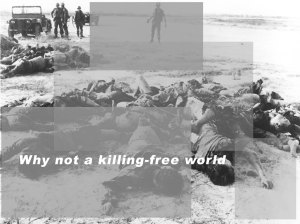
nonkilling world copyThreats to human existence have been predicted, debated and analysed through the ages by mystics and scientists alike and also the science fiction writers and futurists particularly when it comes to meteorites, gamma ray bursts from distant galaxies, super volcanoes, apocalypses and catastrophes of the unknown kind.
There have been warnings, speculation and much amusement as I recall my own childhood reading of H G Wells, when more than a century ago in “The Time Machine” he tried to develop the science of forecasting and I was equally fascinated by Issac Asimov and Arthur C Clarke who do peep into the far futures. Also any talk of our future destiny may be imperfect if we do not speak of mystics like Nostradamus and the ancient Mayans who regularly tried to speculate and even predict the end of the world as we know it.
The outcome of our future destiny has nonetheless remained incoherent despite the best efforts of these pioneers. We are more privileged today as humans have steadily advanced both technologically and sociologically to predict at least our existential future and have developed the will to evolve strategies, deal with impending issues and to an extent mitigate these future disasters. The fact though remains that humans do overestimate the probability of events we know and underestimate events we do not readily recall. Let us for a moment assume that humanity becomes extinct, it would imply a loss of not only lives but also the loss of values, the intelligence, the knowledge and above all the consciousness generated by Homo sapiens through past several millennia. There is evidently a strong moral logic for humans to prevent existential threats of our own making such as wars and global warming from occurring.
Also in retrospect I do wonder, have we deliberated enough on the existential risks that we face today, mostly of our own doing. Yes, indeed we do face risks of just not the big disasters from the realm of the unknown but more importantly disasters that are man-made and recur almost every day in our life and times and these are the ones that may end history as we know. As Robert Burns almost two centuries and a half back commented ‘man’s inhumanity to man makes countless thousands mourn’ when Edmund Burke was compelled to observe that ‘the only thing necessary for the triumph of evil is for the good men to do nothing’. Today we are no different and may be reminded of these ominous words in a world that thrives on violence, terror and killing where we value Mahatma Gandhi, Martin Luther King or for that matter Nelson Mandela only for lip service.
It is in this context that an informal but unique gathering of a most extraordinary league of individuals was held at the Centre for Global Nonkilling with Professor Glenn D Paige from the 11th to 14th June at Hawaii. Indeed I was a participant along with some very unique and outstanding individuals driven and inspired by the cause for a killing-free world from across the globe. I had the opportune moment to further understand and also to highlight some of these threats to the measurable goal of a non-killing world that may or will endanger human existence in the foreseeable future.
One of the prime risk to my mind was the present state of geo-politics that may lead to a war like situation. The driving force may perhaps be purely economic compulsions as substantial parts of globalised economy as yet strives for a magic wand for recovery that does not exist. Be it inflation, unemployment, commodity shortages or even GDP numbers, a recent decision on crude prices by the OPEC actually translates into a war like confrontation with the West. The West on its part clearly understands that if war funding has to come down than the entire middle-East has to be kept under pressure. As per recent estimates despite the end of the Cold War the probability of a nuclear holocaust is one in 1000 in a year and hence any prediction of mass killing that may be the unwitting outcome of any major escalation of geopolitik may not be at all far-fetched.
Next is a bio-engineered pandemic as pathogens are easier to design and as biotechnology gets better and cheaper and as bio-weapons get more accessible even to fringe groups. Lest we forget the Aum Shinrikyo cult that tried to hasten the apocalypse deploying a nerve gas attack. Do we have the hindsight of the leak of methyl isocyanate (MIC) at midnight at the Union Carbide plant in Bhopal that killed thousands of citizens. In the Japanese biowar program since World War II up to 400,000 may have died, far more than those killed by the terrorists. And governments across the globe have killed yet more people in wars across the globe, and even more than in biowar and terror. Not that governments and military or even the industry for that matter, may both wittingly or unwittingly unleash bio-terrorism as a weapon of choice in the hands of a few misguided individuals.
It is said that humans are the crowning achievement of evolutionary history. As humans develop super intelligence and improve cognition through enhancing drugs and artificial intelligence software, traditional civilisational pace of change is increasingly threatened. The explosion in super intelligence may not follow the complex values and diffused morals that have been the cornerstone of the world that we had known until now. But that may be a distant dream and the outcome disastrous considering the explosive growth in human desires, future possibilities and aspirations as Gandhi said there is enough for everyone’s need but not for everyone’s greed. The risk of autonomous and semi-autonomous weapons and systems through advances in nano technology where smart poisons can annihilate a whole population, where gnat bots and self replicating nano machines in the hands of a maniac may result in mayhem and mass killing on a global scale.
It has been estimated that on average a mammalian species survives for a million years and if that be the extinction rate for humans as well than it is going to be much less if we take into account the probability of wars and a nuclear holocaust or any of the other existential possibilities such as hunger, pestilence, climate change or any of those discussed above. Just one possibility where humans have absolute and avoidable control is war and even there our record is not only dismal but a horror story of the worst kind. In last seventy years alone since the end of World War II in some 250 major wars alone 50 million people have been killed, not to speak of those millions who became homeless and the millions injured. Yet we have movies and digital games now that do motivate our youngsters to be the killing machines for a world where revenge and wars are the ultimate goal and not our youth as the harbingers for peace and prosperity in a non-violent and non-killing world.
In our futures exercise at Honolulu we did focus on the preferred assumption of a measurable goal of a non-killing world in the next 30 years in place of a possible or probable world. The unexceptional conclusion was that though a time frame until 2045 may not be a fantasy as such as it can be visualised when we look back at our own past and the pace of change. The non-killing spirit is all pervasive among humans and with the right resolve it may be brought to the fore. Indeed violence and killing is not only self-defeating but also makes the attainment of other goals almost impossible such as sustainable development and universal education, hunger and poverty, conflict resolution and disarmament, human rights and religious tolerance, gender equity and unemployment, and the list goes on.
From times immemorial the all important human trait of cognition and symbolic reasoning led to our cultural explosion and helped our species not only to survive but also to thrive. As humans we not only learnt from our past mistakes but also adapted to variation itself over the the past few millenia, but has our morality really kept pace with our own rapid intellectual transformation. If our own past is any indicator, indeed we have not. The danger is therefore immediate and urgent as existential risks have to be eliminated here and now. Not surprisingly it was felt that a mass movement for a Global Nonkilling World was the only way forward that could bring human consciousness to the next level.

On India’s Tryst with Destiny


On India’s Tryst with Destiny


Anoop Swarup
Anoop Swarup
Anoop Swarup
India’s tryst with destiny is yet a struggle and I as all my countrymen who heard the Prime Minister on the 69th Independence day would be struck by the earnestness of the speech like many other Prime Ministers of India in the past. I will be wide of the mark if I am not driven by the urge and the desire like many of my fellow countrymen to change the country for the better. I do admit that I have a list, not entirely my own, as we recently celebrated the 69th Independence Day 2015.
There are 69 things India is yet to get its freedom from, these are: Corruption, Child Marriage, Cigarette and Tobacco, Honor Killings, Crime against women and children, Stereotyping the LGBT community, Violence against animals, Plastic bags, Use of pesticides, Drugs and trafficking, Public portrayal of women, Urinating in public, “Saas bahu” episodes, Junk food, Violence in Cinemas and the list goes on. Yes like many of us I too have contemplated over the year’s bygone and my own vision of our tryst. In my last five and a half score years, the speech of Jawaharlal Nehru at the stroke of the midnight hour has always haunted me from childhood days. I have wondered if anything has gone wrong and if so, what is wrong with my own people, government, society and the country.
Let us not start with governance and policy in post independence India but for a change let me focus more on the trials and tribulations of the fourth estate and the transforming societal ethos. The first one of course is the uninformed policy discourse that goes on. Our media has been dominated more by assertions and not the hard facts, with the media indulging more on views – motivated ones rather than facts alone and with little scrutiny. The consequences are invariably disastrous as it has in the past not only created but also perpetuated myths and misconceptions. Many in our country believe today that poverty, illiteracy and ill-health afflict India more because of leadership failure at the top and less because of endemic and collective societal failure. We have been exceptionally good in creating rules, programmes, projects and proposals but have been disastrously bad in implementing these. I have pondered on this aspect as I do recall, as most of my readers would, that the values engrained in us through our schooling, from our parents and the society that emerged immediately after independence was of a very idealist fervor. Over the years that spirit is waning and the forces of cut-throat competition and globalization in the digital world of today has taken precedence over ethics, values and ideals. Thus it is not the government and the political leadership alone but the waves of change that sweep our civilizational landscape that have made all the difference to the changing times. I am yet to conclude whether the change is for the better but would like to bring forth the entire dialogue on development and growth that confronts our country. It is a widely held belief that the economic reforms that focused on growth alone have failed the poor, particularly the socially disadvantaged. The gains in poverty alleviation have done precious little in improving the malnourished and their health outcomes because of bad governance, corruption, high population pressure and growth. There have been decisive moments in our nation’s history when we had the urge to decisively demolish some of these barriers to our growth and development. There can be no doubt that India needs reforms urgently be it economic, educational and cultural to lift millions from poverty, deprivation, ignorance, illiteracy and ill-health.
It is true, that India suffers from a lack of ethnic, cultural, linguistic, and religious homogeneity. Also as pointed out by a University Professor abroad much to my chagrin, perhaps we also confront the issue of less than average cognitive abilities compared to many developed countries due to the viscious circle of illiteracy, joblessness and poverty. For these reasons, we have utter indiscipline, disorganization and perhaps lawlessness in the society compared to other Asian or Western countries. How a country with such disparate demography and social cohesion achieve the trust and affluence or is it more likely to be trapped in a catch 22 situation? But then the lack of homogeneity or rather the diversity, is what sets India apart and I had the occasion to expound the same before the United States Foreign Relations Committee in 2004 on Fulbright Visitors programme in Washington when one of the US Senators boasted of an America that was a melting pot for a heterogeneous diversity from across the globe. With all the pride, I could respond and roll out in much detail the virtues of a mosaic or a bouquet that was India where diverse beliefs, thoughts, religions, ethnicity and cultures flourish. In retrospect, to my mind, India should not even aspire to become more homogenous as the real strength of this great democracy is from its variety and diversity. As far as the remark of average cognitive abilities is concerned, I am more skeptical; as literacy levels improve, that will possibly show comparable or even better cognitive levels as amply demonstrated by a bold new tribe of global Indians. I agree however that India may not achieve western levels of affluence in the next quarter century but the overall growth and GDP Inequality may go down only with better investments in education. Low social indicators of India may be the harbinger in several states of greater social inequality and political instability.
APJ Abdul Kalam
APJ Abdul Kalam
APJ Abdul Kalam passed away on 27 July. I had the fortune of being with him for almost a week having invited him at Ahmadabad for the National Youth Festival on the 12th of Jan more than a decade and half ago to mark the Birth Anniversary of Swami Vivekananda. During one of his planned morning sittings ‘Suvichar’ with our youth, he was steadfast in sharing his unequivocal vision – “to transform India from the present developing status to a developed nation”. Later when he became the 11th President of India in 2002 I had several occasions to be with him. Sharing his thoughts and wisdom, I was always struck by his unflinching and greater aim of transforming India in every possible way. Delivering the first Independence Day speech as President of India, he had prophetically said, “The second vision of our nation is to transform it from the present developing status to a developed nation by integrated actions simultaneously in the areas of agriculture and food processing, education and healthcare, infrastructure development, including power, information and communication technologies, and critical technologies. This greater vision will aim to alleviate poverty, illiteracy and unemployment. When the minds of the people of our country are unified and fused towards this vision, the dormant potential will manifest as a mammoth power leading to a happy and prosperous life of a billion people. This vision of the nation will also remove the conflicts arising out of differences and small thinking”.
Prime Minister of India, Narendra Modi, displays a similar spirit like the late ‘Missile Man’, with his focus on the development of the nation. His tasks are enormous ranging from technology to agriculture and from the ‘Swachh Bharat Abhiyaan’ to ‘Make in India’ mission. These sentiments got well reflected in his Independence day clarion call from the ramparts of Red Fort, “I have started making efforts at making the government, not an assembled entity, but an organic unity, an organic entity, a harmonious whole – with one aim, one mind, one direction, one energy… Let’s resolve to steer the country to one destination,” he said and appealed to the 125 crore people of India asking them to eradicate poverty by resolving to move forward with the dream of poverty eradication from India”.
The future beckons us and of course India’s tryst with destiny is like a rendezvous with a distant dream or perhaps a prolonged struggle.

Opportunity beyond the Chinese conundrum and the Indian cacophony


Opportunity beyond the Chinese conundrum and the Indian cacophony


Our World Our Times
Anoop Swarup

Chinese Conundrum and Indian Cacophony
The rise and fall of the Chinese Bull has been much discussed and debated but few on the global stage have cared to look at the role India can play in economic resurgence of the world in a recessionary gloom the world over.
Let us examine the China conundrum and the India cacophony from a world view that remains skeptical and unsparing. As China keeps surprising the world, the shifting gears were apparent in 2012 when the Chinese GDP growth came below 8%, and with rise of labour costs China would loose its edge as the manufacturing hub of the world. Perhaps it may gradually evolve from an asset based to a service and consumption based economy. In contrast India gives some hopes as also some jeers as the growth data released recently for April to June quarter reveals that India as yet struggles to remain the fastest growing major economy for the second quarter in a row with the GDP hovering at 7%.
Considering the world view particularly from Hedge Fund legends such as George Soros in the backdrop of increased global conflicts in past few years in the mid-East and the rivalries in Europe and Asia we may be heading for a global catastrophe once again with China providing the flashpoint. The prediction is based on the fact that the Chinese demand may have to shift from being export driven to domestic. In this scenario, the leaders in China may resort to military conflict in order to stay in power and to prevent the country from breaking down. In case of an adversary such as Japan where the United States may become a party the conflict may turn into a third World war with Russia aligning itself with the Chinese in the words of George Soros.
There are skeptics who fear that just six years since the worst financial crisis since the 1930s yet another one is on the horizon as we have failed to learn from the Greek debt crisis, the Argentine default in 2001 and the looming currency crisis and collapse of the emerging markets such as Malaysia, Brazil and South Africa.. The omen is here and now with DOW and NASDAQ hitting a new low and 99% of S&P 500 facing a worst year.
The problems are being precipitated by rising national debts, the soaring dollar and the unprecedented fall in oil prices. The concern is going to be a real one in case the US Federal Reserve raises the interest rates, perhaps in November 2015. Ann Petti-fog, Director of Policy Research in Macroeconomics asserts ‘We’re going to have another financial crisis.’
In this global backdrop let me explain India’s cacophony of discordance that may well prevail on the Chinese conundrum of opportunity if we do not act fast and pull our act together. Land, Labour and Taxation, in the words of Finance Minister Arun Jaitley a few months ago, were the major pillars of Narendra Modi’s reforms agenda. However, now we may lose out on all these fronts, if we do not act in time. India’s own reform agenda with GST and Land reforms has now hit a major hurdle with the States and the opposition. Coupled with a bad Monsoon there are issues driven and exacerbated more by ineptitude in India rather than climate and act of God such as MAT problem, startling black money laws, delay in bringing about a Direct Taxes Code confusing taxes and disparate laws and no talks of the much needed labour reforms. Modi governments dream budget now appears as a distant dream with the inept handling of the logjam by the discordant opposition in Parliament.
Let us have a look at the economic headlines in the past few weeks, as amid the global economic gloom, triggered by China, India’s growth prospects were seen to be brighter than those of other emerging markets. The fact also remains that after its worst single-day washout of 1625 sensex points and a sharp rupee depreciation of 82 paise against the US dollar, both stocks and currency bounced back gaining 291 points and 55 paise respectively in just a day.
China’s slowdown is just one of its problems. Its debt is pegged at 282% of GDP by some estimates compared to India’s at 32%. Its growth has been export led compared to India’s domestic demand driven. Reserve Bank of India Governor Raghuram Rajan tells us why it is different this time, and how India is no more in the club of the ‘Fragile Five’ or ‘Troubled 10’ with all the reasons for brighter prospects.
As India seeks better ratings with S&P, Moody’s Investor’s Service maintains that India’s macro economic indicators have improved over last few years and that will help India withstand any volatility in global capital flows. Let us not forget that India is blessed with a huge domestic market and a large stock of cheap workforce, if we ensure a national mission on skilling the demographic dividend, India will have more opportunity to get investments. Thanks to its resilient consumer spending and improving macroeconomic fundamentals, India is to a great extent insulated from any global crisis and this is best asserted in the words of Finance Minister Arun Jaitley who said: ‘the crisis should be converted into an opportunity to grow by speeding up the reforms’. And he is not off the mark in pointing out ‘India, with 8-9 per cent growth rate, can replace China as the driver of world economy’.How much and when that would happen will not only be a defining moment for ‘Modi and India’ but also set the stage for coming of age of a new and resurgent India and for the ‘Elephant versus Dragon’ story to be complete.

Friday, July 4, 2014

OpenBook: CONTRACT WITH GOD

OpenBook: CONTRACT WITH GOD: Have you ever had a dialog with GOD? Well I guess I am fortunate to have had that opportunity in my early years as a young man and sin...

Thursday, April 3, 2014

"A world Not So Ordinary"

Today I wondered on the relevance of the ordinary individual and the contributions of the multitude of women and men who have