Thursday, September 10, 2015

Let there be fireworks on five star activism, introspection, scrutiny and Judicial Reforms


Let there be fireworks on five star activism, introspection, scrutiny and Judicial Reforms


Anoop Swarup
The issue of five star activism and what drives the judiciary has been raked up by Prime Minister Narendra Modi and it has become a subject matter of intense debate particularly on new media. The issue does stir up a hornet’s nest and underscores the need for a closer look at the two oscillating ends–perception and reality. On this focal point, the obvious corollary is the need for judicial introspection, a point so succinctly raised by the Prime Minster – though equally stoutly defended by the Chief Justice of India at the Conference of Chief Ministers of States and the Chief Justices of the High Courts.
Anoop Swarup
Anoop Swarup
We have to be mindful that probity and truth should never be compromised for fear of contempt on the edifice of upholding judicial integrity or purported divinity. In a democracy people have the right to know the truth and justice should neither be delayed nor denied but delivered every time. Individual rights, judicial integrity and independence though hallmarked in a democracy have to time and again stand the test of public scrutiny over time as enshrined in the Constitution. The set customary law and conventions can in no case take precedence to the dictum that ‘truth alone should triumph’ in the end. We should not forget that values imbibed over the ages may conflict invariably with rights to liberty, free speech and expression guaranteed by the Constitution and on grounds of public morality, national interest and defence.
Also the overall good of the people, public interest and a due process of inquiry to find the truth in a specific case will have to take precedence even at the expense of individual’s rights. Thus judicial activism even if considered to be five star opens up to scrutiny not only judicial pronouncements and legislative intent but also our existing notions of right or wrong even if it has been tested earlier before a Court of Law. Thus very much like the other three pillars in a democracy judiciary even if considered divine Mr Prime Minister and constitutionally guaranteed should be open to introspection and scrutiny.
The issue of five star activism and what drives the judiciary has been raked up by Prime Minister Narendra Modi and has become a subject matter of intense debate particularly on new media. The issue does stir up a hornet’s nest and underscores the need for a closer look at the two oscillating ends–“perception and reality”. On this focal point, the obvious corollary is the need for judicial introspection, a point so succinctly raised by the Prime Minster – though equally stoutly defended by the Chief Justice of India at the Conference of Chief Justices and the Chief Ministers. Let us delve into a few examples, Shreya Singhal who fought the IT Act’s 66A Case in the apex court, was perhaps a five star activist who had indeed safeguarded our right to freedom of expression; in the Rhea Pillai matter the pronouncement by Delhi High Court, the views of the Court on the Nirbhaya BBC Documentary; giving people the right to reject and the list goes on. Let me also ask, in Subramanian Swamy’s filing of 2G and 3G matters – was the judiciary responding only to perceptions and why should the judicial pronouncements in Bhopal Gas tragedy be not open to public debate and scrutiny in larger public interest as it may be alleged that the Courts were influenced by five star activism of the government in power at the time. Yes we may very well question five star activism at Kudakulum Power Plant and finally let me ask the question is Teesta Setalwad, a five star activist? Ironically enough when she approached the UNCHR she was pulled up by none other than the Supreme Court of India.
Thus judicial scrutiny by the Courts themselves can be a matter of five star activism. Why judiciary should not be not brought in the ambit of the right to information? Is it a ominous warning to the hitherto unquestioned judiciary, perhaps not, and was the Chief Justice really countering the Prime Minister? It may be said that brevity is not the soul of wit but the centre point of a strong argument, both for and against. So let us examine the issue further even at the cost of contempt. I recall almost three decades ago, while posted in Kolkata I had to run from pillar to posts at great personal risk to have the stays vacated against smugglers from all over the country as we found to our dismay that in about four score COFEPOSA matters anticipatory bails were taken from a particular judge of the High Court that too surreptitiously on Holidays by invoking the constitutional writ jurisdiction of the Court by showing residence in the Andaman Islands by unscrupulous Counsels.
Thus in the infamous Coalgate case where Prashant Bhushan had filed a petition on Coal Block allocation was it a matter of judicial activism? Someone wittingly commented that Coal had indeed turned into diamond for some. I do find it amusing that the entire discussion in the public domain has centred around the culpability of ex Prime Minister Man Mohan Singh rather than the overall intent of the policy and its departure in so called larger public interest coloured even more by criminality and conspiracy in the actual manner of Coal Block allocation. Supreme Court’s relief to the former Prime Minister from summons of the Trial Court, though not a clean chit, may be questioned on grounds of jurisdiction and on finer legal arguments. But as observed by some, we should not loose track of the fact that there was a departure from an established policy since 1993 to 2005 where the process followed involved a screening committee and that the auctions were shelved ostensibly at the behest of the States that have an unique responsibility in respect of the sources in their jurisdiction. Was it a political consideration and a deeper conspiracy involving vested interests of all political hues that were hand in glove with private interests that the then Prime Minister overruled coal allocation in favour of a private party Hindalco? I do vividly recall a case where as early as in 1990 that we had detected a case of duty evasion at Kolkata Customs on pitchblende by Hindalco.The defraud to the exchequer and criminality if any could only be investigated by a professionally run CBI that is free of the ruling government’s diktat and a well informed and proactive judiciary as a watch dog on executive functioning and may well be the final recourse in our democratic polity.
Then there is the matter of judicial oversight on political decisions and lets take the case of misplaced priorities for good governance as the Chief Minister of the newly set up Telengana State buying Toyota Fortuner SUVs and latest in the series is purchasing of IPhones at a cost of INR 30 crore from the starved State finances just to appease the bureaucracy, an irony that besets our country’s poor record of governance in the States. Let me remind the readers that in Telengana, farmers are starving and the State is facing a debt of INR 61,710 crore necessitating an austere budget. These and the so called pre poll bonanzas such as cheap rice, free waivers and doles being distributed from the exchequer in many States where the politicians deserve to be under judicial scrutiny.
Therefore the question remains whether the judiciary is really divine as was mentioned by the Prime Minister or can be influenced in our country by unscrupulous counsels and judges acting in tandem with undesirable elements and the law-breakers. In fact judicial activism has been the hallmark of our judicature since independence and has made India proud on several occasions as is appreciated the world over. Perhaps, even if it was a mere exchange of ideas by the Prime Minister with the Judiciary any amount of introspection will always be welcome. The fact remains that it is actually the five star activists, both within the judiciary and beyond who have, through public interest litigation, judicial scrutiny and oversight, brought to the fore, issues that range from rights of individuals to upholding freedom and liberty, public interest and national interest, ethics and morals by refining and redefining our values and of course the course of judicial reforms and for good governance. After all and in the end it is ‘Truth alone that should Triumph”, let there be ‘Satyameva Jayate’ for the judiciary and our country.

Food, clothing, shelter and Internet: For a world more equitable and E-nnovative

Food, clothing, shelter and Internet: For a world more equitable and E-nnovative

Anoop Swarup​
​As regulator TRAI is primed to secure the interest of the Consumer and to safeguard Constitutional guarantees such as the freedom of speech and expression but it is indeed an irony that it has set in motion proposals that would not only hurt the consumers because access to some services will be costlier but also hurt enterprise, entrepreneurial growth and smaller Internet businesses
Anoop Swarup
Anoop Swarup
As the world watches the Telecom Regulatory Authority of India (TRAI) and the policy makers are considering a strange set of rules that will allow cable and phone companies to create fast and slow lanes on the Internet that will curb not only the freedom of the digital media but also the costs to the consumers by dictating decisive dominance of what, how and why in the cyber world.
As regulator TRAI is primed to secure the interest of the Consumer and to safeguard Constitutional guarantees such as the freedom of speech and expression but it is indeed an irony that it has set in motion proposals that would not only hurt the consumers because access to some services will be costlier but also hurt enterprise, entrepreneurial growth and smaller Internet businesses in contrast to what we should be doing that is prohibiting differential delivery and monopolistic and restrictive trade practices by telecom companies that may block or slow content to the consumers.
Rightly enough, in the United States the Federal Communications Commission has recently adopted very strong net neutrality rules that would prevent cable and phone companies from creating fast and slow lanes on the Internet. However, interestingly as a retrograde step, the European Union, with its 28 national governments, is considering a proposal that would allow telecommunication companies for preferential treatment and to charge more for Internet businesses such as Netflix and Google for their content to be delivered faster than other smaller companies. As a cue, our telecommunication regulator TRAI is considering whether it should adopt a provision similar to what Europe is considering. In a move that may be even worse, TRAI has also asked if telecom companies should be able to charge users extra fees for services like YouTube, WhatsApp and Skype on top of the fees people already pay for access to Internet.
Let me further explain why net neutrality more than anywhere in the world is so critical for India. In a certain sense, internet is not at all different from electricity. Sure enough electricity companies are vested with its distribution and access only and are neutral to its usage. It will be a confounding and an amusing situation if we find that the electric companies are putting different meters with differential tariffs for different makes of fridges, air conditioners and lighting. Thus Net Neutrality is not very different than the electricity that we consume daily, but here it is about the data that we consume on the internet. In broad terms, the internet service providers such as Airtel and Vodafone should not be allowed to discriminate the way we choose or use the internet or the brands that we use to surf the internet. I may mention that I do like most of us do use Quora, to write long and often boring answers; WhatsApp to message my friends and at times to never reply back; Gmail for my personal mail id when communicating; YouTube to watch the IPL or Roger Federer, over and over again. But that may all change if the telecom companies have their way.
At the centre of the storm is Airtel Zero, let us have a relook at this collaboration between Airtel and certain other companies (what has come as a breather is the news that Flipkart has pulled out of Airtel Zero) or perhaps Snapdeal and Amazon in which consumers such as us, supposedly may not have to pay for the data that we consume to use their applications. Let us now examine the consequences as we go more deep into this disingenuous act for us. Yes indeed, we may be forced to change brands as consumers will move to what is free rather that what is best. We may be forced to change our usage behavior as we may never be able to share a YouTube video because our ‘Videos Pack’ offered by the service provider may not have been bought by all. This, as mentioned earlier, would obviously discourage new competition as also further innovation and creativity as no one will dare compete for economic reasons as no one will ever partner with telecom majors. More than anything else there would be no more competition amongst the telecom service providers as other companies would be forced to do the same and thus promote unfair and restrictive trade practices.
Therefore in India as much as in Europe, policy makers are working on the misguided notion that higher charges are going to keep telecommunications companies in business that have the inherent rights as they have built networks and should be paid for the costs of creating, maintaining and upgrading networks being used and exploited by Internet companies like Google and Facebook. This is an argument that is far from the real facts as telecom companies across the globe do charge money from individuals and businesses through regular fees for access to their network that includes the operational costs. It is only incidental that costs have fallen over time as with all businesses, and yet the telecom companies still make profit as they have always done.
In our country though activists have organized campaigns against TRAI’s proposals that appears to be having some impact, yet Ravi Shankar Prasad, the Minister for Communications and Information Technology, tweets that the government would study the issue closely before adopting final rules. As commented by him, the Internet – an innovation of the fast changing world – does belong to all humanity and not to a few and is a big leveler for the youth of our country having unleashed economic growth and prosperity for our country as we have witnessed in the past few years like no other invention. Internet is fast becoming a necessity, and now are the days of ‘Roti, Kapda, Makaan’ (Food, clothing, shelter) and of course you guessed it right, Bandwidth. The success of the internet as we have seen is its accessibility, the omnibus nature of its usage and versatility of its contents and delivery.
The worst thing our policy makers will ever do, if they do not leave alone the motivated dictat of the telecom companies, is tinkering with the knowledge revolution now in the making for a world more equitable and more innovative, that we in India now take pride in.

Public is paying a heavy price for the countenance to the corrupt Babudom: Is the Modi Government watching?

Public is paying a heavy price for the countenance to the corrupt Babudom: Is the Modi Government watching?

Anoop Swarup
Do we need an incompetent bureaucracy or a committed adhocracy
Anoop Swarup
Anoop Swarup
I may sound overly sceptical perhaps angry, yes I am, as are scores of my patriotic fellowmen, on the state of the nation and more particularly on the plight of the poorest of the poor. As is more often than not, the case, the usual blame game ends with a finger pointing towards either the politicians, hereinafter referred to as the netas, a popular connotation for the political leadership in India and the bureaucrats or the civil servants, now being referred to as the babus, a term that will be taken up in more detail later in this column. Thus it is the netas and the babus both past and present. who are more often than not considered to be the ostensible culprits for all our woes. It is in this backdrop that I felt it prudent to investigate the very ethos and the reasons behind the very genesis, the necessity and the compulsions of the babudom in our country in these contemporary times of the digital age. When it comes to public sentiments against the netas, they invariably and always get away under the guise of being public representatives and the babus, since most of them are always too ready and willing to serve the interests of their political masters, remain insulated, receive endless protection, and continue to rise the ladders of success. Irrespective of the ruling class or party in power the babus wield enormous power and influence over the decision-making process within the government that remains more like a feudal order that refuses to make way even 65 years after India became Republic and allow the transition to a healthy democratic and federal system as perceived by the founding fathers of the Constitution of India. Despite huge public anguish the babus more particularly the IAS do proclaim being a professional band of civil servants and the metaphors do run wild from being a so-called steel frame to the nation to a necessary evil that runs the affairs of the state as the third pillar in a democratic State.
Let us now briefly study the Collins Thesaurus of the english language that defines bureaucracy as a noun and as ‘government, officials, authorities, administration, ministry, the system, civil service, directorate, officialdom, corridors of power’. Of course true to its functions bureaucracies do tend to stifle enterprise and initiative but also are the best safeguards against the whims and fancies of those in power. But as the saying goes “power corrupts and absolute power corrupts absolutely” we have a scenario in India where this is more of a norm rather than an exception as those in power including both the bureaucrats and the politicians often do form an unholy nexus. It also implies a corrupt bureaucrat politician nexus and not mere red tape, regulations, paperwork, officialdom, officialese, bumbledom and the list goes on. Incidentally in the federal polity of India those working in the states have a much more happier time as the three central services assigned to the States i.e. the IAS, IPS and the IFS do end up with more than their fair share of the power clout and the nexus becomes complete with the Members of the Legislative Assembly heading a number of state run enterprises ranging from the fisheries corporation to state-owned contraptions handling power generation and distribution to industries development and leather corporation – all being run with the help of the public exchequer as a hang over of the socialist past.
While the State run autonomous corporations have turned into grazing grounds for the netas and babus, critical institutions such as primary and secondary school education, health and infrastructure are in a shambles. Those babus who maintain even a fair degree of honesty either follow the safe formula and go for the thumb rule that ‘no decision is the best decision’ or land up postings that hardly matter for those who only command what are called the “money spinning” posts
Never before the Babus could imagine that they would be seeing their senior head towards Delhi’s Tihar jail for approving documents as asked by Telecom Minister A Raja. Insiders in the babudom who did smell the wrongdoings in distribution of 2G licenses, are convinced that Siddhartha Behura, a 1973 batch IAS, who is languishing behind bars since 2011 might not have been a party to the entire conspiracy as he had joined as Telecom secretary much later in the day. In contrast the fact remains that the Babus who were directly or indirectly indicted for wrongs in Commonwealth Games 2010 somehow escaped with mild punishments as is normally the case like transfer to the parent cadre. Amusingly, the Babus were apprehensive from day one that Right to Information Act (RTI) would force them to be on the receiving end on every decision they took. But as the grapevine is and as it has unfolded now, the bureaucrats have now started raising more questions on the file to be better safe than sorry to the detriment of prompt decision making in the interest of good governance.
Incidentally, managing investigators is now more of a taboo as more often than not the CBI is being monitored by an over eager judiciary as also the Income Tax and Enforcement Directorate sleuths do become adventurous and target the high and mighty to land with a spectacular catch as was the case with the IAS Joshi couple in Madhya Pradesh. The CBI raid on a former telecom secretary Shyamal Ghosh, a 1965 batch IAS officer is an indication that a Babu may be haunted and hauled up for his decision even after his superannuation. The Babus who had hitherto wanted “plum posts” in ministries such as economic affairs, finance, roadways, tourism, commerce and industry, are now shying away and scouting for “safer abodes in social sector ministries. A Babu who awards a contract now must gather intelligence on a number of aspects which he had hitherto conveniently ignored before even while angling for a prize post. This was the case when a Member Engineering of the Railway Board discovered much to his chagrin when an erstwhile Railway Minister was found using his nephew to source the much wanted post in the Railway Board.
More often than not it is the nexus between the politicians and the mafia more particularly the netas and the babus of India, so well brought out by the Vora Commission in the aftermath of 1993 blasts while I was with the Directorate of Revenue Intelligence. Indeed this was the time of revelation personally to me as I may recall having arrested a senior BSF officer with huge quantities of heroin from the Amritsar border. Also having worked on the infamous stock market Harshad Mehta case, followed by several others convinced me that the long hand of law may not reach out to those who are well connected and who operate through an unholy nexus with the politicians in power. The discovery of huge remittances by the now well-known defence dealer Abhishek Verma with his own set of political connection was handed over to the enforcement directorate by us at Revenue Intelligence but the same apparently made little headway as I later found out, perhaps and in retrospect as I see the nation could have averted more such defence deals with timely acton. It was a time when we cracked the Vizag Steel Plant case of DEEC fraud where a very senior IAS Officer who had functioned as the the Director General of Foreign Trade and some very senior officials of Vizag Steel Plant. They, in connivance with a number of politicians in power, had masterminded one of the most ingenious commercial frauds of the time. Unfortunately both the anti-smuggling case and the anti-corruption matter could not reach their logical conclusion both with the DRI and the CBI respectively despite our best efforts as the politico legal forces had joined hands in the end. Incidentally, public memory is short and this very important file of Vora Commission on bureaucrat politician nexus along with the recommendations is now gathering dust in the corridors of North Block.
When it comes to ethics, morals and values in our babucracy let us have a quick revisit to the very infamous episode when our Indian Foreign Service officers were shocked and angry after they had heard the news that one of their colleagues Devyani Khobragade, a doctor-turned IFS officer of 1999 batch and the then Deputy Consul General of India in New York, was arrested by law enforcement authorities in New York City when “she was dropping her daughter at school”. Khobragade, who was later released on bail, was arrested on the basis of allegations raised by the officer’s former India-based domestic assistant, Sangeeta Richard. Ms. Khobargade was accused of giving false information while applying for a visa for a “babysitter and housekeeper”, and also of underpaying the help. The chargesheet against her implied a jail term up to 15 years. Incidentally she did what every other Indian diplomat does in the US to secure a visa for their servants. Unfortunately, in her case the maid walked away and sought legal protection, which brought the dirty baggage in the open. A wrong is a wrong, howsoever you may wish to defend the indefensible.
Government sponsored banners run across the globe, on incredible India today, yes ironically the Telecom Regulatory Authority or the TRAI after a amazing and uncalled for public consultation process against net neutrality has now come up with yet another bloomer and that is to expose the very privacy of those very netizens it was meant to protect. And the list goes on, as there have been several other instances at the TRAI, to name a few: the delay, perhaps deliberate in bringing about number portability amongst the operators, the delay in doing away of unwanted roaming charges and the differential and complicated tariff structure that most subscribers as yet do not understand. Well one may be lead to believe that either this would be a case of gross incompetence or blissful ignorance. In either case it is the public at large that has to pay for the apathy and ignorance and the public is paying a heavy price for the countenance to the corrupt Babudom. Is the Modi government watching?
It is in news that under new rules being finalised by the Centre, the state governments will have to inform the Centre within 48 hours about the suspension of an all India services officer.The new service rules being formulated by the Centre for top bureaucrats will ensure that Babus do not remain suspended beyond a week except for prior sanction of a review committee. Let us be sure that the new set of rules do not lead the babudom to further complacency as it is the interest of the common man and not the interest of the politicians and bureaucrats that should count at the end of the day. I may mention that to add to the country’s development dilemma in addition to the bureaucratic apathy, perhaps incompetency , the party in power has to contend with an opposition that is on a virtual war with the ruling party. As we may observe over its predicament over the Land Bill now on the anvil. We have seen Spectrum being allowed for free, Coal mines handed over for free. What has happened to the paralysis of decision making, the integrity and agility of the babudom, the rational discourse in our legislatures and also in the media. Are we caught in a catch 22 situation as a country? Is the Prime Minister worried!
Yes, I am worried more for the bureaucracy than any one else as that was supposed to be a very competent and professional institution, more importantly a committed steel-frame as was envisaged by our founding fathers. It is high time that we in India consider a bureaucracy in the higher echelons as one that is non-permanent and that is loyal to the country instead of the service or the party in power. A babudom that is not feudal in its mindset but a forward looking agile and committed force to be reckoned with, perhaps in line with a system of governance now followed in the western world known as ‘adhocracy’. As we talk about ‘adhocracy’ now in vogue in many developed countries – a form promoted by Alvin Toffler in 1970 as a structureless problem solving organisation. It has often been used in the theory of management of organisations in a tecehnotronic age and popularised by academics such as Henry Mintzberg. Let India look forward to a Babudom that is neither corrupt nor incompetent but is professionally more responsive to the masses and to the constitution for an India. Let us have a fresh rethink to review and reform for a modern progressive bureaucracy for an India that is not feudal but is modern and progressive Mr Prime Minister before it is too late for India.

Salman Khan, 2002 hit-and-run case and the Indian Justice delivery system

Salman Khan, 2002 hit-and-run case and the Indian Justice delivery system

Anoop Swarup
Anoop Swarup
Anoop Swarup
My head hangs in shame as I cannot speak against the judiciary in a free and democratic India where my right to expression and freedom of speech is guaranteed by the Constitution.
Yes, there are over 3 crore cases pending in our courts while scores facing prosecution continue to languish in jails or so many others have breathed their last hoping for justice, which remains a far cry for countless citizens. Yet the ‘rich and famous’ of India, so often get away from the long arm of law and this would continye until the nation gets a conscience and rises for the have nots.
Our laws and court processes are antiquated from the British Raj but have adapted well to the Money Raj of modern India. As the media trial goes on even as the High Court grants bail to Salman Khan, the anguish of the common man is at its peak and to top it all, this morning I saw a very sarcastic message taking rounds on WhatsApp ‘People have lost faith in the judiciary today … but if Salman had not got the bail people would have lost faith in money too’. The public perception is a telling commentary on the state of affairs in India today. Yes, no one is above law, but for sure in posterity we will look back to agree that there are humans who can always rise above law, in free India.
Well this is not just about actor Salman Khan and the 2002 hit and run case or for that matter even his 2008 black buck case and a few other matters that did or did not end up in the courts. But it is, thanks to Salman, that we once again have the opportunity to talk about inequity, inequality and injustice in our society, and about a tale of two nations, ‘India and Bharat’ where same law and same judicial process have been allowed to be partial.
As about the media and the film fraternity of India, who have spared no thought for the victims, the solidarity and all the talk of justice delivered appears ridiculous perhaps hypocritical. Mr. Khan, you have been gracious enough to thank all those who prayed for you but please do also spare some time for your own conscience as being human is not running away from the site of the accident and delaying the process of justice on various technical, or perhaps flimsy grounds. But you are not alone in this as in my free country a good and competent lawyer employs a man of law who is well connected and is also good in subverting the process of justice on various technicalities.
The national television channels for the last three days have been on a hyper drive, nothing has been more important in this world of ours than : Salman gets 5 years for hit & run, What next for Salman ! Salman, Bail or Jail! 2002 Hit and Run. Salman didn’t provide medical aid is well made out in the 240 page judgment. It was apparent that Ashok Singh was a got up witness as the tyre burst theory was rejected, apparently for 13 years Salman didn’t admit he was driving. As it transpires now the defense lawyer’s approach was perhaps fallacious as to who was the driver: Altaf or Ashok who was driving from J W Marriott. When it comes to crime and punishment it is almost 13 years since that fateful night in Mumbai that the star is convicted for culpable homicide not amounting to murder under Section 304-II IPC- 5 years imprisonment and INR 25000/- fine read with Section 338 IPC, causing grievous hurt by act endangering life or personal safety of others, one year simple imprisonment and Rs 500/- fine, Section 337 IPC, causing minor injuries, three month simple imprisonment and fine, Section 187 Motor Vehicle Act, failing to give information on name address and license to police, three month simple imprisonment and Rs 500/- fine, Section 185 of Motor Vehicle Act, drunk driving, six month simple imprisonment and Rs 2000/- fine, Section 3(1) read with 181 of Motor Vehicle Act, driving without license, 2moth imprisonment and Rs 500/- fine.
I am also equally compelled to share this piece that is taking rounds on the new media that the visual media has not fully taken cognizance of: The reason why Salman Khan and his advocate are alarmed at Ravindra Patil’s statement is because Patil is the only eye witness in this case. He was sitting next to Salman Khan on the dreadful night of September 28, 2002, when Salman Khan under the influence of alcohol drew his car recklessly. In his statement, recorded by the magistrate, Patil had categorically declared that Salman Khan was under the influence of alcohol and despite his repeated requests to let him drive, Khan ignored his pleas and rammed his car into a bakery in suburban Bandra, killing one person and injuring four others who were sleeping on the pavement. After the ugly accident Ravindra Patil was the first person to lodge an FIR against Salman Khan as a concerned citizen. However later he had to pay a heavy price for his civilian act. Though Patil was a constable in Mumbai police and employed as a body guard to Salman Khan, he was immediately stripped off duty as Khan’s body guard due to his bold remark. Soon he was also pressurized by his department to change his statement. But he was adamant. Later the pressure became so extreme that Patil was compelled to flee from Mumbai so that he could not be present during trial in the court. Patil’s absence was cleverly exploited by Khan’s men as Patil was declared an absconder by the judge for not being present in the court. A warrant was issued and without hearing Patil’s pleas he was arrested and sent to Arthur Road jail. To make his life worse his police job was also stripped! With no job Patil’s family too abandoned him and he was left to begging. The young and handsome Patil’s condition deteriorated to such an extent that he contracted TB and was reduced to skeleton! He was last seen by a news reporter at the Sewri Municipal hospital in Mumbai in 2007. Despite such hardship and humiliation Patil was adamant on his stance regarding Salman Khan’s statement in the hit and ran case.
We came across a series of lies from the appearance of Ashok Singh – accepting that he was driving and not Khan and a sudden change of statements by Khan himself that present a discomforting picture of an actor who runs the Being Human charity. The court antics in fact wash away all the good work that he may have done. Patil died an unsung death on October 4, 2007 lamenting that neither the society heard his cries nor God paid heed to his pleas.
The question remains, is Bollywood out of touch with the world and the ground reality. The convict in this case Salman Khan, who is now out on bail, had no valid license, was responsible for not only rash and negligent driving but was under the influence of liquor and has been indicted for culpable homicide not amounting to murder. Perhaps rightly enough one of the panelists on TV was fuming that a case of perjury should be made out for a got up witness and that 340 CrPC for false evidence the term of 7 years should have been applied as the entire made up defense case had boomeranged. Salman Khan ’s paradropped alibi was strongly opposed in the trial court, but the appeal against the quantum of sentence, why was Kamal Khan allowed to get away by the prosecution were taken as valid arguments by the High Court. Now again the facts do speak for themselves as the captions and banners in prime time media channels and the print media run: 13 year delay in trial but just 48 hours for bail, 13 years on and no closure for the victims, even without a copy of the entire judgment, will you be heard this quick, the High Court was kept open beyond thet 5 pm closing time for the common man, special treatment indeed. Is speedy justice only for those who can afford and book the top lawyers. The extreme alacrity in the deliverance of justice has been debated time and again. In the instant matter, I shall not discuss that any further as the matter is subjudice and I cannot afford a contempt.
Yes in the bold new world of today, it is not news any more but views that drive the info media! and one of our national newspaper was more concerned with the ‘Stars many moods” and the stoic expression on the actor’s face, to add to our star obsessed mindsets the actor who had all along been merrily away from the long arm of law could also manage with a two day bail even after conviction on the grounds that he did not get judgment copy. The last straw, indeed was the observation of the Hon’ble Judge of the High Court that the charge of culpable homicide we discussed above, requires serious consideration as he asked the public prosecutor “Why will this … not be a case of only rash driving” and went on to pronounce the bail orders on a bond of Rs 30,000. In the end it was the extreme alacrity and speed of the due process of law that perhaps was the winner apart from Salman Khan and his defense counsel.
It is said that the person with the long leg cannot be caught by law, as more importantly though everyone is said to be equal before law, but the vice versa need not be true as the same law can always be applied differently. I always thought that bail should be the rule and jail should be an exception, yet amazingly 2.43 lakh of our fellow countrymen who lack the resources to afford the rising cost of lawyers or cope with the whole process of the judicial delivery system are forced to languish behind bars without any bail! Will each of them get the same treatment?
At the end of the day it appeared, thanks to the glitterati of our country that it was perhaps Salman Khan who appeared to be the victim and not those who were mowed down and injured and the unfortunate soul who lost his life. Indeed that led me to wonder as to what has gone wrong with my country’s conscience.

On India’s Century: How Narendra Modi can propel India to move forward as a global power

On India’s Century: How Narendra Modi can propel India to move forward as a global power

Anoop Swarup
Anoop Swarup
Anoop Swarup
As we celebrate one year of Narendra Modi government, the May 18th issue of Time carries a portrait of Narendra Modi on its cover and the Editor Nancy Gibbs goes at length to state that though Barack Obama may be the leader of the world’s most powerful democracy, the distinction of leading the largest one belongs to Narendra Modi. Indeed the world is watching us as Obama recently wrote about Modi in a Time 100 issue it is now expedient for India to move into the fore front of nations by force of will and conviction. It is also equally important that India’s future history does not repeat its past tale of missed opportunities? There has been much media hype on the first year of the Modi Government and its achievements and failures but few had really looked forward to propose the next few steps that can propel us to make the next century as India’s century. Let me devote this column to that onerous task and propose a future forward. Also in the same measure let me mention that it is not Modi’s NDA versus Rahul’s UPA or for that matter, the BJP versus the Congress with all the cacophony of the past but a more defining approach to nation building that the Prime Minister should now pursue as the people have now given him the decisive mandate for change after almost 30 years.
In my last week Column I had elaborated on the eve of Modi’s foreign visit that the Elephant and the Dragon, together as the two billion plus economic giants can forge a future for the whole world. I had been passionate that the long march is indeed possible only through a strategic give and take on the border, economic synergy, joining hands on the global war against terror, joint endeavors and better investments on manufacturing and agriculture, climate change and new technologies, water resource planning, manpower skilling to resource the world as an economic powerhouse. I had made a case that the opportunity is here and now for the Indian Prime Minister Narendra Modi and the Chinese President Xi Jinping, so that the Asian Century may take shape.
First, is Governance and that implies real and representative organizational framework at local levels and a committed leadership at the helm supported by an honest and responsive civil service. Governance is therefore a double edged sword and the Prime Minister should take urgent and immediate steps not only to reform the leadership structure at the top but also the existing bureaucracy from an outdated feudal civil service comprising the IAS, IPS, IRS, IFS, and the rest to a modern, progressive and responsive civil service. India should urgently ensure as prevalent in most progressive societies that the higher bureaucracy, at the rank of a Director/Joint Secretary and above in the Union government and the Secretary/Principal Secretary and above in the States be hired as specialists through a transparent process by the Union Public Service Commission on contractual term basis with distinct key performance indicators, identified result areas and performance outcomes. Also in the States now the very dysfunctional and obsolete District Administration should be thoroughly revamped with only specialists running major government departments and functions with strict monitoring, evaluation and targeted time frames. On the law and order and policing front we should bid adieu to the outdated colonial mindset that had the oversight of an ICS District Magistrate over the Superintendent of Police from Indian Police who in most cases was from an army background and there used to be a justification he being ill informed of civilian law and norms. We do now have a professionally trained policing for almost 60 years where the IPS officers are better trained to administer civil policing the earlier logic now appears preposterous. The Police should have absolute control over their domain as in most advanced countries in the interest of better performance and leave magisterial functions to a more committed judiciary to be inducted as Indian Judicial Service officials like the rest of Civil Service. The top echelons in diverse and specialized departments such as Public Works, Health, Irrigation, Revenue and Education can be hired on contractual basis so as to be more responsive for delivery on strict time frames whereas lower functionaries may be retained as is now prevalent through the State Public Services. The organizational change for prompt delivery and responsiveness can only be driven by a more specialized professional specialist with independent functioning than a generalist Indian Administrative Service Officer who at the helm at the District level has a plethora of functions, all under one cap. He not only finds it almost impossible to do justice to anyone but also and more often than not is inclined to maintain the status quo. I may mention that at the Panchayat level and at the Municipal level now the time is indeed ripe in our country to have a more involved and decentralized approach to governance as in vogue in the county and city council structure of the west where the prime focus is on citizen centric participatory development and delivery rather than on mere revenue collection and administration.
Second, is corruption as that only bleeds the individual but also infects the entire society and it starts from the very top. It is indeed high time that our legislators, the Lok Sabha, the Rajya Sabha MPs as also the Vidhan Sabha MLAs are driven by the highest common factor and not the least common denominator. Therefore it is imperative that the legislators who deliberate and frame our policies and who legislate the nation’s priorities and concerns are not only literate enough but are also educated well. These should as leaders of an emerging India join the party on raised bar as graduates with no criminal history, due disclosure of both movable and movable assets and be free of corrupt and criminal history. Any further procrastination or deception on our part on any purported consideration will sure be a disaster in the making for the country at large and a recipe for a societal failure. It would be even more necessary for the selection of our Ministers both at Centre and State levels, where with foresight and better planning it can be ensured that the ruling party has commitments and internal guidelines to follow good practices for representative candidate selection and enrolment. Without any further delay we have to ensure that the selection to the statutory bodies and anti-corruption bodies such as the Comptroller and Auditor General, the Central and State Vigilance Commissions, the Central Bureau of Investigation and the state Lokayukta and Economic Offences Wing, is made on an impartial basis without the say of either the ruling or opposition parties so that they do function and perform with integrity and honesty.
Third is the immediate and outright need to revamp the Indian Judiciary, reform the legal regime and also to throw away to the bins the infamous Collegiums for selection of higher judiciary. There are over three crore cases now pending in our Courts mostly on flimsy grounds. Mr Prime Minister let us give our bright young law graduates an opportunity to serve the nation and on merit alone reach the very top that is the High Courts and the Supreme Court through an Indian Judicial Service that can function professionally right from the district and subordinate Courts. As you once very rightly observed judicial activism. even if five star, should now be opened up to scrutiny. That implies that not only judicial pronouncements and legislative intent should be on a watch but also our existing notions of right or wrong even if it has been tested earlier before a Court of Law. Thus very much like the other three pillars in a democracy, judiciary even if considered divine need not be in ivory towers Mr Prime Minister. In a free democratic society where constitutionally guarantees of freedom of expression and speech are inbuilt we should be open to introspection and scrutiny in the interest of better performance and higher efficiency for the common man. It is equally important to urgently rationalize and simplify our laws and regulations in every sphere that are an unwanted anachronism from our feudal past for a just, transparent and progressive regime that favors initiatives, innovations, facilitation and ease of compliance instead of evasion, avoidance and control of a bygone Inspector Raj that promotes inefficiencies, corruption and delays.
Fourth is India’s Strategic Defense and Foreign Policy preparedness and response. I vividly recall that once in the early 90s during my interaction one fine evening with Late General K Sundar ji while at the Defense Staff College at Wellington that he commented on India’s strategic response to a particular foreign policy intervention that he surmised that it was nothing more than a fuzzy logic of decisive indecisiveness. How true, when in retrospect I do feel that he was not off the mark as our foreign policy reaction as much as our homeland security response to many threats both internal as well as external, have been of implied and supplied indifference. That I believe should now be changing having cognizant of Narendra Modi’s bold pugmarks both on defense inland and foreign policy offshore initiatives.
Fifth and perhaps the most important is the investment in Education Mr. Prime Minister. Once Peter Drucker famously quipped that today knowledge has power, it controls access to opportunity and advancement. The question is, are we doing enough as the youngest nation when we rethink skilling, teaching and learning. I believe that the time is ripe to ensure that our demographic dividend does not turn out to be a demographic disaster. On an urgent basis we should identify the constraints, problems and challenges in school teaching both at secondary and tertiary levels relating to curriculum, infrastructure, administration and better access. One issue that is now a global issue is to explore methods of attracting and retaining talented faculty members. Attempt should be made to suggest measures to develop a research tradition particularly in the Universities where it is important to provide a level playing field to private entrants. Across the globe some innovative approaches have been made to raise standards and promote excellence in higher education in the wider social context. A case in point is the Massive Open Online Courses (MOOC), the Virtual Class Rooms and Technology Enabled Learning now in vogue that is changing the teaching landscape across the globe and is going to be a great leveler for India. It is also critically important that we explore and suggest ways of incorporating emerging changes in teaching and curricula as John F. Kennedy believed that knowledge is the frontier of tomorrow and the America that we know made it a mantra for its policy makers. Obviously, in India also emerging knowledge has to keep pace with the changing paradigms in the educational environment and will require identification of problems implicit in regulatory structures that constrain the quality and spread of education. The Ministry of Human Resources will have to set its vision for teaching standards in education, evaluate its status today, and build a roadmap and a broad strategy to reach those goals. It is not at all farfetched to treat as vital investment in knowledge, innovation and creativity as it pays the best interest.
To conclude, I may mention that it was amusing enough to find Rahul Gandhi on the floor of the Parliament calling the government a Suit Boot ki Sirkar and quick was the retaliation from Arun Jaitley that it was a Sooj Bhooj ki Sirkar. Indeed let us for the moment believe that this will indeed be a Government that works and that would deliver!

A measurable goal for a Nonkilling World

A measurable goal for a Nonkilling World


Anoop Swarup
(From Honolulu, Hawaii)
nonkilling world copyThreats to human existence have been predicted, debated and analysed through the ages by mystics and scientists alike and also the science fiction writers and futurists particularly when it comes to meteorites, gamma ray bursts from distant galaxies, super volcanoes, apocalypses and catastrophes of the unknown kind.
There have been warnings, speculation and much amusement as I recall my own childhood reading of H G Wells, when more than a century ago in “The Time Machine” he tried to develop the science of forecasting and I was equally fascinated by Issac Asimov and Arthur C Clarke who do peep into the far futures. Also any talk of our future destiny may be imperfect if we do not speak of mystics like Nostradamus and the ancient Mayans who regularly tried to speculate and even predict the end of the world as we know it.
The outcome of our future destiny has nonetheless remained incoherent despite the best efforts of these pioneers. We are more privileged today as humans have steadily advanced both technologically and sociologically to predict at least our existential future and have developed the will to evolve strategies, deal with impending issues and to an extent mitigate these future disasters. The fact though remains that humans do overestimate the probability of events we know and underestimate events we do not readily recall. Let us for a moment assume that humanity becomes extinct, it would imply a loss of not only lives but also the loss of values, the intelligence, the knowledge and above all the consciousness generated by Homo sapiens through past several millennia. There is evidently a strong moral logic for humans to prevent existential threats of our own making such as wars and global warming from occurring.
Also in retrospect I do wonder, have we deliberated enough on the existential risks that we face today, mostly of our own doing. Yes, indeed we do face risks of just not the big disasters from the realm of the unknown but more importantly disasters that are man-made and recur almost every day in our life and times and these are the ones that may end history as we know. As Robert Burns almost two centuries and a half back commented ‘man’s inhumanity to man makes countless thousands mourn’ when Edmund Burke was compelled to observe that ‘the only thing necessary for the triumph of evil is for the good men to do nothing’. Today we are no different and may be reminded of these ominous words in a world that thrives on violence, terror and killing where we value Mahatma Gandhi, Martin Luther King or for that matter Nelson Mandela only for lip service.
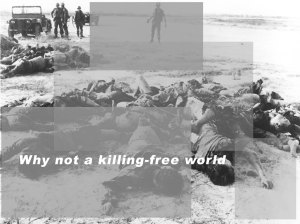
It is in this context that an informal but unique gathering of a most extraordinary league of individuals was held at the Centre for Global Nonkilling with Professor Glenn D Paige from the 11th to 14th June at Hawaii. Indeed I was a participant along with some very unique and outstanding individuals driven and inspired by the cause for a killing-free world from across the globe. I had the opportune moment to further understand and also to highlight some of these threats to the measurable goal of a non-killing world that may or will endanger human existence in the foreseeable future.
One of the prime risk to my mind was the present state of geo-politics that may lead to a war like situation. The driving force may perhaps be purely economic compulsions as substantial parts of globalised economy as yet strives for a magic wand for recovery that does not exist. Be it inflation, unemployment, commodity shortages or even GDP numbers, a recent decision on crude prices by the OPEC actually translates into a war like confrontation with the West. The West on its part clearly understands that if war funding has to come down than the entire middle-East has to be kept under pressure. As per recent estimates despite the end of the Cold War the probability of a nuclear holocaust is one in 1000 in a year and hence any prediction of mass killing that may be the unwitting outcome of any major escalation of geopolitik may not be at all far-fetched.
Next is a bio-engineered pandemic as pathogens are easier to design and as biotechnology gets better and cheaper and as bio-weapons get more accessible even to fringe groups. Lest we forget the Aum Shinrikyo cult that tried to hasten the apocalypse deploying a nerve gas attack. Do we have the hindsight of the leak of methyl isocyanate (MIC) at midnight at the Union Carbide plant in Bhopal that killed thousands of citizens. In the Japanese biowar program since World War II up to 400,000 may have died, far more than those killed by the terrorists. And governments across the globe have killed yet more people in wars across the globe, and even more than in biowar and terror. Not that governments and military or even the industry for that matter, may both wittingly or unwittingly unleash bio-terrorism as a weapon of choice in the hands of a few misguided individuals.
It is said that humans are the crowning achievement of evolutionary history. As humans develop super intelligence and improve cognition through enhancing drugs and artificial intelligence software, traditional civilisational pace of change is increasingly threatened. The explosion in super intelligence may not follow the complex values and diffused morals that have been the cornerstone of the world that we had known until now. But that may be a distant dream and the outcome disastrous considering the explosive growth in human desires, future possibilities and aspirations as Gandhi said there is enough for everyone’s need but not for everyone’s greed. The risk of autonomous and semi-autonomous weapons and systems through advances in nano technology where smart poisons can annihilate a whole population, where gnat bots and self replicating nano machines in the hands of a maniac may result in mayhem and mass killing on a global scale.
It has been estimated that on average a mammalian species survives for a million years and if that be the extinction rate for humans as well than it is going to be much less if we take into account the probability of wars and a nuclear holocaust or any of the other existential possibilities such as hunger, pestilence, climate change or any of those discussed above. Just one possibility where humans have absolute and avoidable control is war and even there our record is not only dismal but a horror story of the worst kind. In last seventy years alone since the end of World War II in some 250 major wars alone 50 million people have been killed, not to speak of those millions who became homeless and the millions injured. Yet we have movies and digital games now that do motivate our youngsters to be the killing machines for a world where revenge and wars are the ultimate goal and not our youth as the harbingers for peace and prosperity in a non-violent and non-killing world.
In our futures exercise at Honolulu we did focus on the preferred assumption of a measurable goal of a non-killing world in the next 30 years in place of a possible or probable world. The unexceptional conclusion was that though a time frame until 2045 may not be a fantasy as such as it can be visualised when we look back at our own past and the pace of change. The non-killing spirit is all pervasive among humans and with the right resolve it may be brought to the fore. Indeed violence and killing is not only self-defeating but also makes the attainment of other goals almost impossible such as sustainable development and universal education, hunger and poverty, conflict resolution and disarmament, human rights and religious tolerance, gender equity and unemployment, and the list goes on.
From times immemorial the all important human trait of cognition and symbolic reasoning led to our cultural explosion and helped our species not only to survive but also to thrive. As humans we not only learnt from our past mistakes but also adapted to variation itself over the the past few millenia, but has our morality really kept pace with our own rapid intellectual transformation. If our own past is any indicator, indeed we have not. The danger is therefore immediate and urgent as existential risks have to be eliminated here and now. Not surprisingly it was felt that a mass movement for a Global Nonkilling World was the only way forward that could bring human consciousness to the next level.

On India’s Tryst with Destiny


On India’s Tryst with Destiny


Anoop Swarup
Anoop Swarup
Anoop Swarup
India’s tryst with destiny is yet a struggle and I as all my countrymen who heard the Prime Minister on the 69th Independence day would be struck by the earnestness of the speech like many other Prime Ministers of India in the past. I will be wide of the mark if I am not driven by the urge and the desire like many of my fellow countrymen to change the country for the better. I do admit that I have a list, not entirely my own, as we recently celebrated the 69th Independence Day 2015.
There are 69 things India is yet to get its freedom from, these are: Corruption, Child Marriage, Cigarette and Tobacco, Honor Killings, Crime against women and children, Stereotyping the LGBT community, Violence against animals, Plastic bags, Use of pesticides, Drugs and trafficking, Public portrayal of women, Urinating in public, “Saas bahu” episodes, Junk food, Violence in Cinemas and the list goes on. Yes like many of us I too have contemplated over the year’s bygone and my own vision of our tryst. In my last five and a half score years, the speech of Jawaharlal Nehru at the stroke of the midnight hour has always haunted me from childhood days. I have wondered if anything has gone wrong and if so, what is wrong with my own people, government, society and the country.
Let us not start with governance and policy in post independence India but for a change let me focus more on the trials and tribulations of the fourth estate and the transforming societal ethos. The first one of course is the uninformed policy discourse that goes on. Our media has been dominated more by assertions and not the hard facts, with the media indulging more on views – motivated ones rather than facts alone and with little scrutiny. The consequences are invariably disastrous as it has in the past not only created but also perpetuated myths and misconceptions. Many in our country believe today that poverty, illiteracy and ill-health afflict India more because of leadership failure at the top and less because of endemic and collective societal failure. We have been exceptionally good in creating rules, programmes, projects and proposals but have been disastrously bad in implementing these. I have pondered on this aspect as I do recall, as most of my readers would, that the values engrained in us through our schooling, from our parents and the society that emerged immediately after independence was of a very idealist fervor. Over the years that spirit is waning and the forces of cut-throat competition and globalization in the digital world of today has taken precedence over ethics, values and ideals. Thus it is not the government and the political leadership alone but the waves of change that sweep our civilizational landscape that have made all the difference to the changing times. I am yet to conclude whether the change is for the better but would like to bring forth the entire dialogue on development and growth that confronts our country. It is a widely held belief that the economic reforms that focused on growth alone have failed the poor, particularly the socially disadvantaged. The gains in poverty alleviation have done precious little in improving the malnourished and their health outcomes because of bad governance, corruption, high population pressure and growth. There have been decisive moments in our nation’s history when we had the urge to decisively demolish some of these barriers to our growth and development. There can be no doubt that India needs reforms urgently be it economic, educational and cultural to lift millions from poverty, deprivation, ignorance, illiteracy and ill-health.
It is true, that India suffers from a lack of ethnic, cultural, linguistic, and religious homogeneity. Also as pointed out by a University Professor abroad much to my chagrin, perhaps we also confront the issue of less than average cognitive abilities compared to many developed countries due to the viscious circle of illiteracy, joblessness and poverty. For these reasons, we have utter indiscipline, disorganization and perhaps lawlessness in the society compared to other Asian or Western countries. How a country with such disparate demography and social cohesion achieve the trust and affluence or is it more likely to be trapped in a catch 22 situation? But then the lack of homogeneity or rather the diversity, is what sets India apart and I had the occasion to expound the same before the United States Foreign Relations Committee in 2004 on Fulbright Visitors programme in Washington when one of the US Senators boasted of an America that was a melting pot for a heterogeneous diversity from across the globe. With all the pride, I could respond and roll out in much detail the virtues of a mosaic or a bouquet that was India where diverse beliefs, thoughts, religions, ethnicity and cultures flourish. In retrospect, to my mind, India should not even aspire to become more homogenous as the real strength of this great democracy is from its variety and diversity. As far as the remark of average cognitive abilities is concerned, I am more skeptical; as literacy levels improve, that will possibly show comparable or even better cognitive levels as amply demonstrated by a bold new tribe of global Indians. I agree however that India may not achieve western levels of affluence in the next quarter century but the overall growth and GDP Inequality may go down only with better investments in education. Low social indicators of India may be the harbinger in several states of greater social inequality and political instability.
APJ Abdul Kalam
APJ Abdul Kalam
APJ Abdul Kalam passed away on 27 July. I had the fortune of being with him for almost a week having invited him at Ahmadabad for the National Youth Festival on the 12th of Jan more than a decade and half ago to mark the Birth Anniversary of Swami Vivekananda. During one of his planned morning sittings ‘Suvichar’ with our youth, he was steadfast in sharing his unequivocal vision – “to transform India from the present developing status to a developed nation”. Later when he became the 11th President of India in 2002 I had several occasions to be with him. Sharing his thoughts and wisdom, I was always struck by his unflinching and greater aim of transforming India in every possible way. Delivering the first Independence Day speech as President of India, he had prophetically said, “The second vision of our nation is to transform it from the present developing status to a developed nation by integrated actions simultaneously in the areas of agriculture and food processing, education and healthcare, infrastructure development, including power, information and communication technologies, and critical technologies. This greater vision will aim to alleviate poverty, illiteracy and unemployment. When the minds of the people of our country are unified and fused towards this vision, the dormant potential will manifest as a mammoth power leading to a happy and prosperous life of a billion people. This vision of the nation will also remove the conflicts arising out of differences and small thinking”.
Prime Minister of India, Narendra Modi, displays a similar spirit like the late ‘Missile Man’, with his focus on the development of the nation. His tasks are enormous ranging from technology to agriculture and from the ‘Swachh Bharat Abhiyaan’ to ‘Make in India’ mission. These sentiments got well reflected in his Independence day clarion call from the ramparts of Red Fort, “I have started making efforts at making the government, not an assembled entity, but an organic unity, an organic entity, a harmonious whole – with one aim, one mind, one direction, one energy… Let’s resolve to steer the country to one destination,” he said and appealed to the 125 crore people of India asking them to eradicate poverty by resolving to move forward with the dream of poverty eradication from India”.
The future beckons us and of course India’s tryst with destiny is like a rendezvous with a distant dream or perhaps a prolonged struggle.